Category: Government

  • A Shooting in Glendale Puts Short Term Rentals in the Spotlight. Here’s Where the Issue Stands in Whitefish Bay.

    A Shooting in Glendale Puts Short Term Rentals in the Spotlight. Here’s Where the Issue Stands in Whitefish Bay.

    A 22-year-old man was shot at a short term vacation rental on the 1000 block of W. Riverview Dr. in Glendale in May. The same house reportedly saw a guest drown in the Milwaukee River in 2024. At this week’s common council meeting, Glendale took a hard look at how it regulates short term rentals.  While Whitefish Bay has not had the same level of headline grabbing issues with short term rentals, our village board took similar action in November of last year to regulate those types of rentals more closely. 

    How It Started in Whitefish Bay

    A group of neighbors on the 4700 block of North Larkin Street spent the better part of 2025 organizing, documenting their concerns, showing up to village board meetings, and collaborating with village staff. The result was the unanimous passage of an ordinance at the November 17th village board meeting — Whitefish Bay’s first comprehensive regulatory framework for short term rentals.

    The spark came from a single Airbnb that opened on North Larkin in January 2025 and, according to neighbors, never stopped being rented. Residents described a revolving door of renters, a property manager who wouldn’t respond to anyone, trash going weeks without collection, and a general erosion of the block’s stability. They brought their concerns to village leadership, who directed staff to draft an ordinance.

    What staff found when they started looking at the time: there were 17 active short term rental properties in Whitefish Bay and more than 70% of them were operating without a license from the North Shore Health Department. The police department stated that they had received four calls over the prior year across those properties (each call was for a separate/distinct house – in other words, no single house incurred multiple calls).

    What the Ordinance Does

    Village staff drafted rules requiring anyone operating a short term rental to obtain an annual village license for $300. The application requires a Wisconsin State Department of Revenue sellers permit, a North Shore Health Department permit, proof of short term rental insurance, and notification of all property owners within 200 feet of the property.

    The key restriction implemented is a 7-day minimum stay, the most restrictive the village is legally permitted to impose under Wisconsin state statute, and an occupancy cap of two guests per bedroom plus two additional occupants. Property managers must respond to complaints within 12 hours of an outreach. Three violations from any combination of police, code compliance, or the health department within a 365-day period triggers license revocation. Operating without a license at all exposes owners to daily fines.

    Wisconsin’s Complicated Legal Landscape

    One reason Whitefish Bay’s board was so focused on threading a legal needle: municipalities across Wisconsin (and the country) that have tried to crack down on short term rentals have found themselves sued.

    In July 2025, the Wisconsin Realtors Association won a court case decided by the Wisconsin Court of Appeals. The court struck down Neenah’s ordinance requiring short term rental properties to be the primary residence of the applicant, ruling it conflicted with Wisconsin’s right-to-rent law. In another 2025 case, the Village of Summit had attempted to regulate short term rentals through general police powers rather than through its zoning code — and lost on procedural grounds.

    Fast forward to 2026

    The Village shared with the WFB Buzz that three licenses have been issued for short term rentals to date. There are an additional two applications that are pending approval as those two locations work to obtain their State Department of Revenue and North Shore Health Department permits. No applications have been rejected to date. 
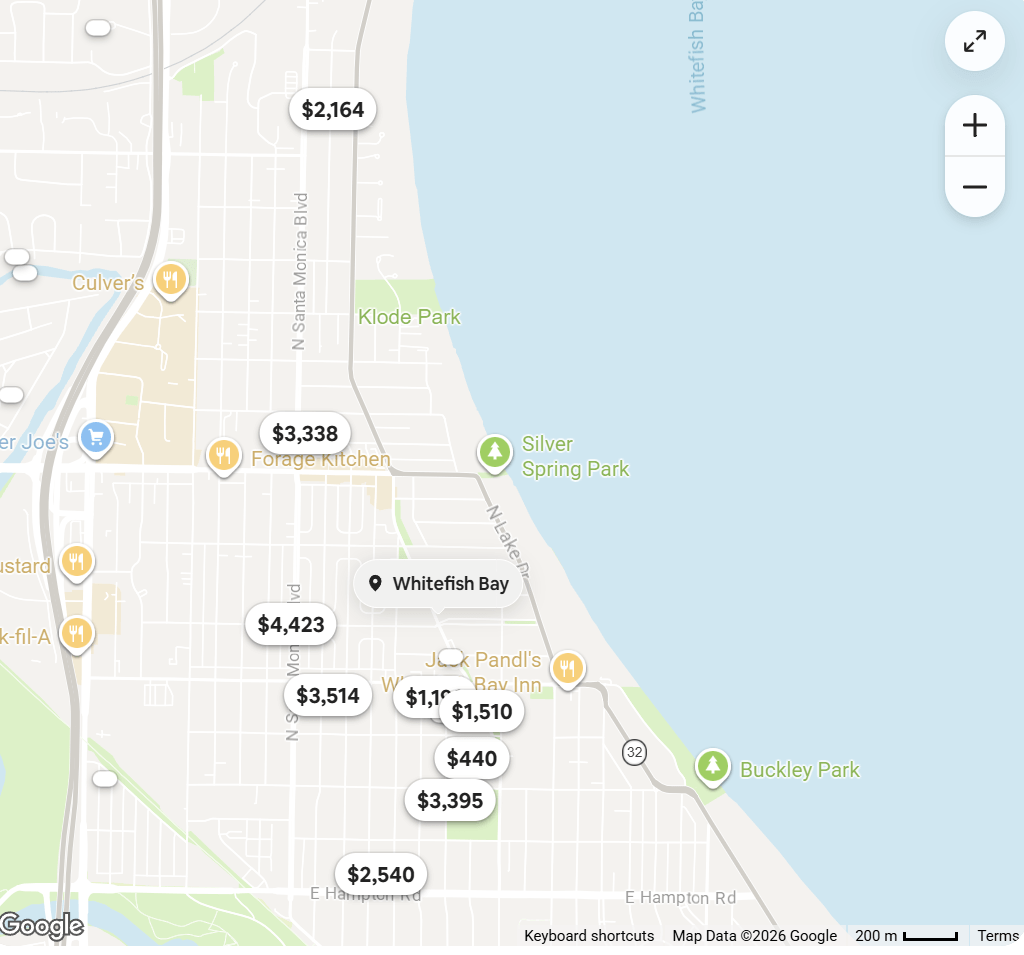
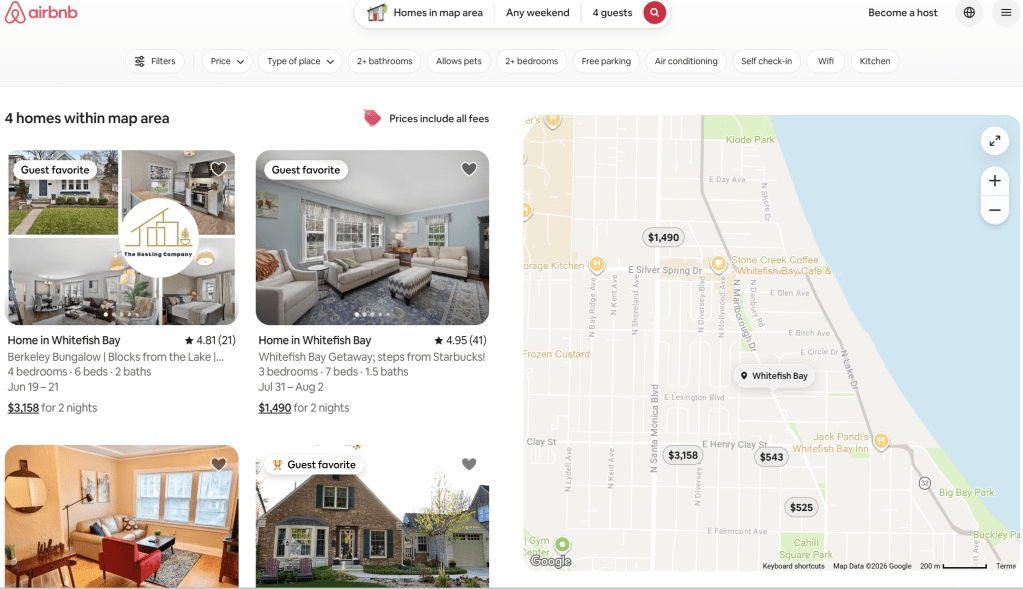
    A Snapshot of an Airbnb Search of Available Rentals from June 2026

    When performing an [admittedly very unscientific] experiment myself, 13 properties showed up in the village limits of Whitefish Bay on Airbnb (using no parameters on number of guests, length of stay, or period of stay). Only 1 property showed up on VRBO, which was a duplicate of a property also visible on Airbnb. When filtering by weekend availability, four properties showed up, which would not align with the minimum 7 day ordinance. 
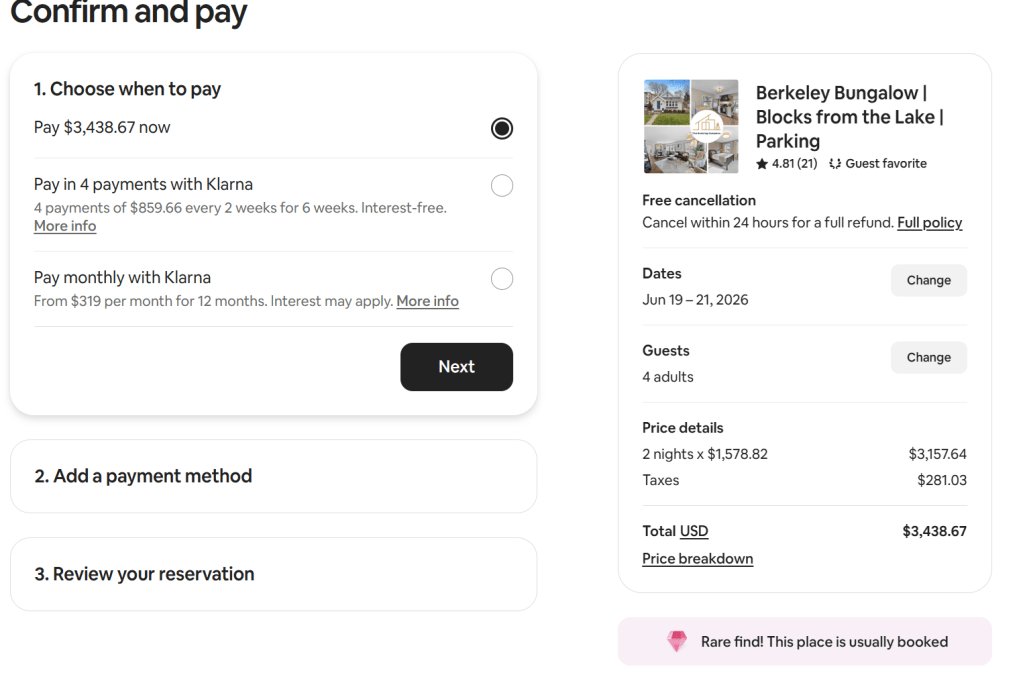
    The Village also shared that they have received written and/or verbal confirmation from other property owners stating they are not actively operating as a short term rental despite still showing up in the booking platforms. While ironing out the compliance details as the ordinance is still in its infancy, the Village will likely rely on information displayed in the online booking platforms rather than those written/verbal confirmations going forward as an indication of a rental being operational. 

    Raw Emotions Shown

    Similar to the Whitefish Bay board discussions on the topic last year, the Glendale Common Council was largely sympathetic to the cause of residents hoping for stronger regulation of short term rentals in Monday’s meeting. The ordinance used similar language to that used in Whitefish Bay’s and passed 4-2. 

    Emotions were raw in the Glendale meeting and from what I could see watching online, one individual was removed from the meeting by police after repeated outbursts. For context, no one I spoke with in our village could recall needing to remove an attendee at a Whitefish Bay meeting in at least the past decade!

    With three licenses issued, two pending and at least 13 listings apparently live, the gap between the ordinance on paper and the rentals in practice will be something to watch in 2026.
  • Slowing Down Lake Drive: Whitefish Bay Unveils Traffic Calming Concepts for Five Intersections

    Slowing Down Lake Drive: Whitefish Bay Unveils Traffic Calming Concepts for Five Intersections

    If you’ve ever felt like traffic on Lake Drive moves too fast (and I’m sure there are those of you who think it moves too slow!) through Whitefish Bay, village leadership would seem to agree with you, and Monday’s Public Works Committee meeting includes recommendations on current proposals to calm traffic.

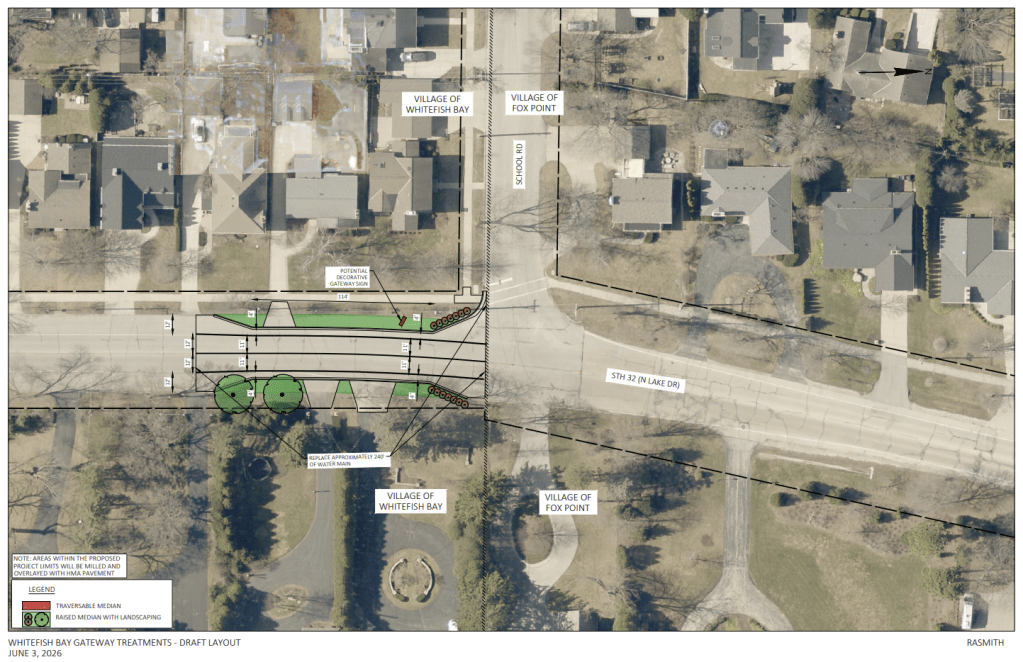
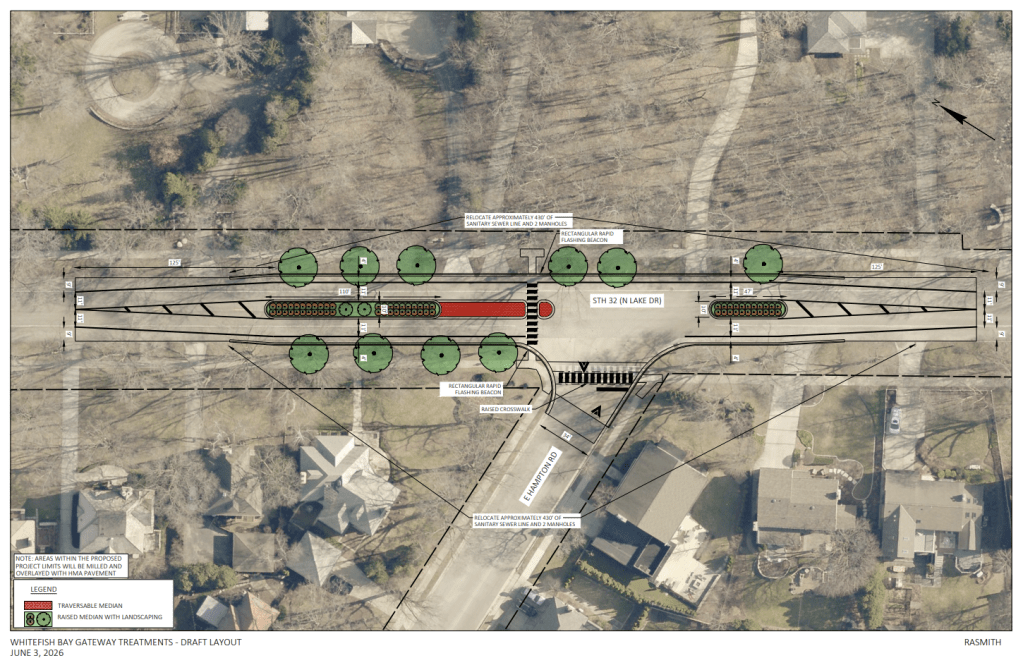
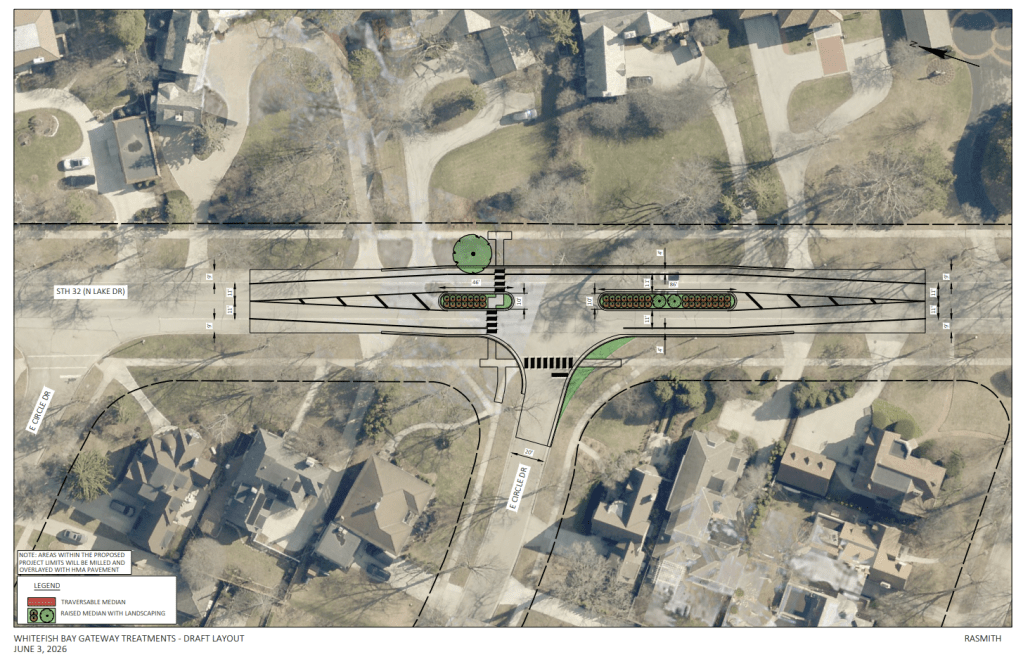
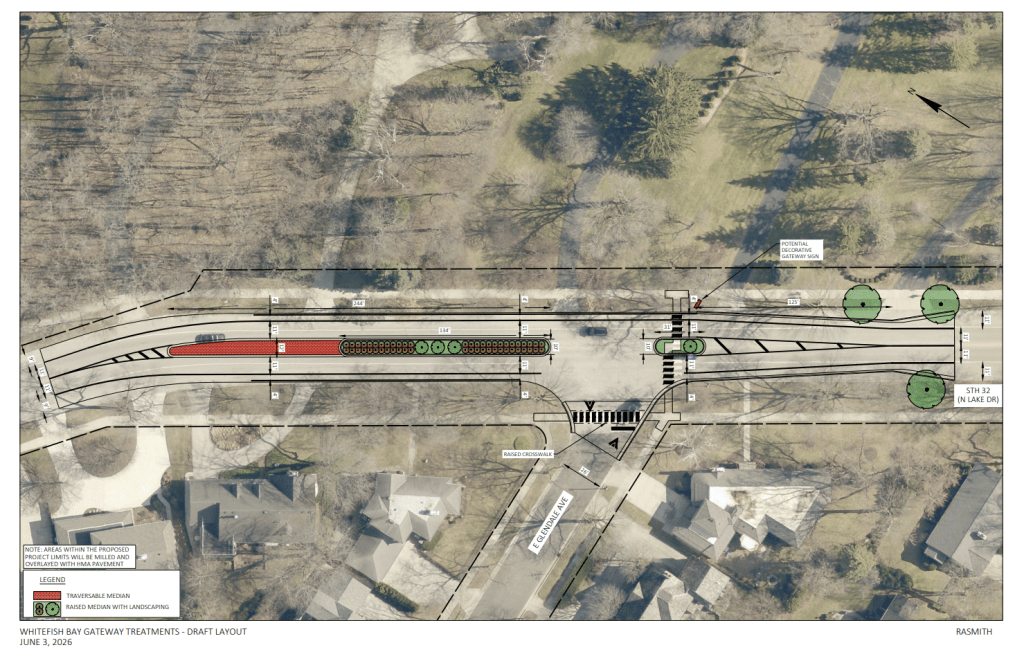
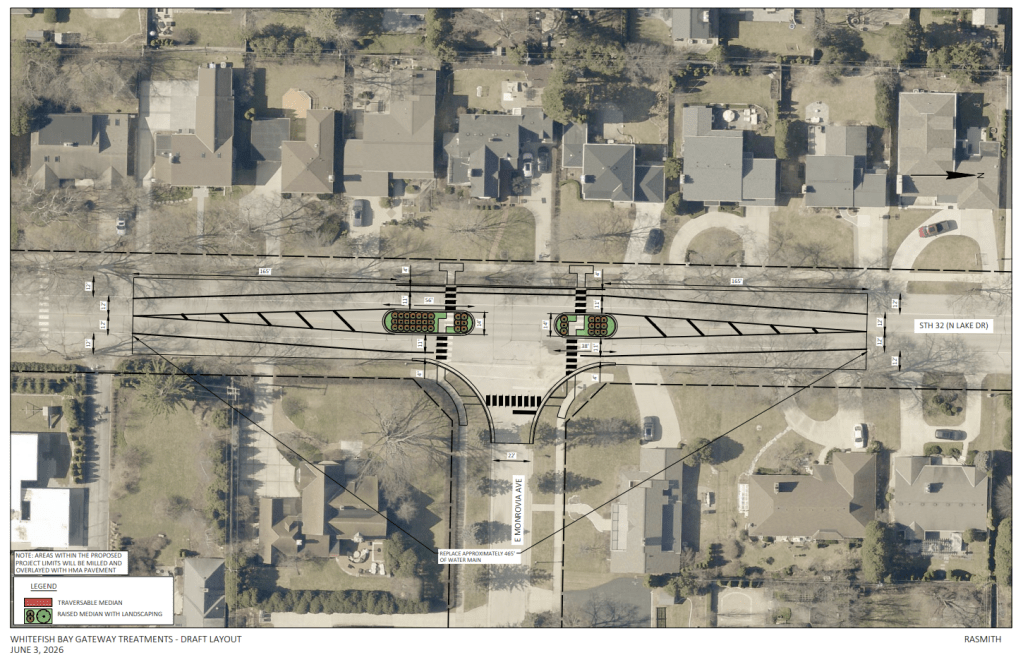
    The committee meets at 5:30 p.m. on Monday to review conceptual designs and cost estimates for traffic calming “gateway” treatments at five Lake Drive intersections, developed by engineering firm raSmith. The concepts are part of a broader push to secure federal grant funding and improve pedestrian and cyclist safety along the village’s busiest and highest-speed corridor.

    The Five Locations

    The proposed gateway treatments target the following intersections along Lake Drive:

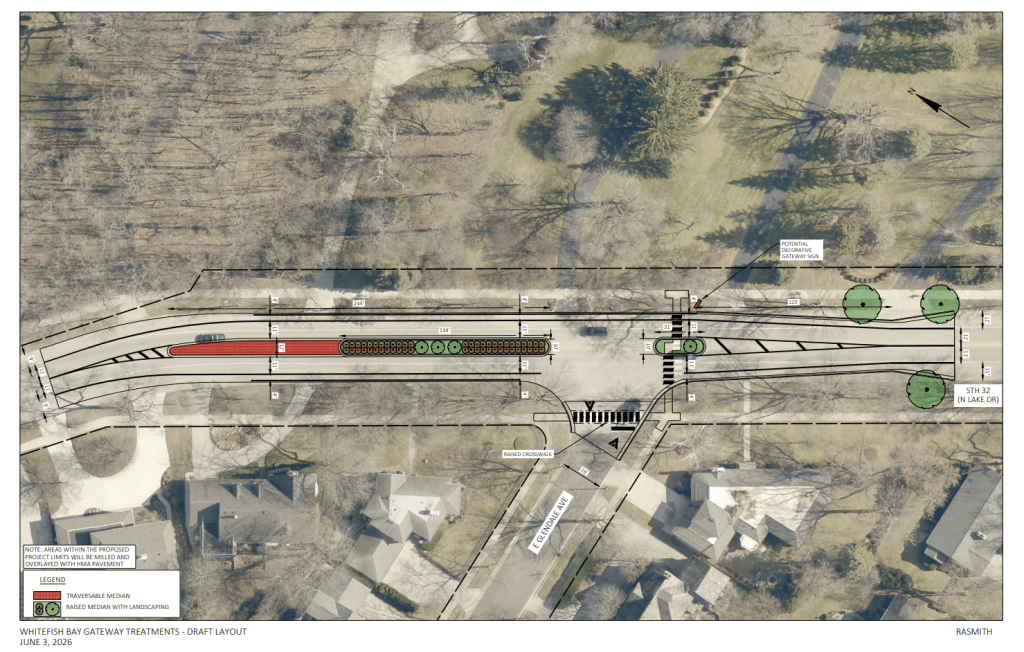
    • Lake Drive & Glendale Avenue
    • Lake Drive & Hampton Road
    • Lake Drive & Circle Drive
    • Lake Drive & Monrovia Avenue
    • Lake Drive & School Road

    Each location would receive some combination of raised crosswalks, raised and traversable medians with landscaping, curb and gutter improvements, improved pedestrian ramps, and bike lane delineation. The Glendale and School Road locations are proposed to include decorative gateway signs, marking the village’s entries.

    The Price Tag

    Milwaukee County has applied for federal grant money, a portion of which would be dedicated to Whitefish Bay’s project. The county expects to hear back on the application’s status by fall 2026, with projects anticipated for construction between 2028 and 2030. The total estimated project cost across all five locations is $3 million in 2030 dollars (the anticipated construction window). If the federal grant is awarded, $2.3 million would be eligible for participation in federal grant reimbursement, with the additional $764,000 completely locally funded, including utility relocation, water main replacement, and light pole relocations that don’t qualify under the grant program.

    Try It Before You Build It

    One notable element of the village’s approach: staff is recommending that the conceptual designs also be used to set up temporary traffic calming features using delineators at the proposed locations before any permanent construction begins. The idea is to give residents and the village a trial period to observe real-world effects, gather feedback, and refine the final designs before committing to the full build. You have probably noticed the same approach in the village around town – at the high school on Marlborough and Colfax, on the 100 block of Lake View leading into Bayshore, and on Santa Monica outside St. Monica School.

    Also on the Agenda: New School Zone Signs on Lake Drive

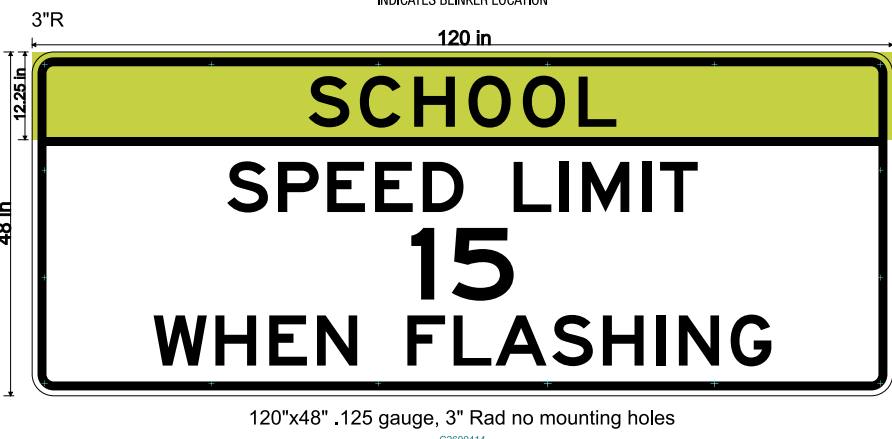
    A second item on the agenda addresses the overhead school zone signs on Lake Drive near Richards Elementary School. The existing signs have been non-functional for years, with broken lights, outdated technology, and electrical connections that are no longer working.

    Staff is recommending replacing them with new solar-powered, LED programmable signs that will flash during school drop-off and pickup times. The new signs are 10 feet wide and 4 feet tall and will use solar panels rather than the existing electrical setup. DPW staff would handle the installation themselves to save on contractor costs. The total cost for the updated signs is estimated at $19,000.

    As has been the case in Whitefish Bay and all across Milwaukee, the village is looking to use infrastructure design to nudge drivers into treating major thoroughfares more like the neighborhood street it runs through.

  • A Community Gem: Whitefish Bay Public Library by the Numbers

    A Community Gem: Whitefish Bay Public Library by the Numbers

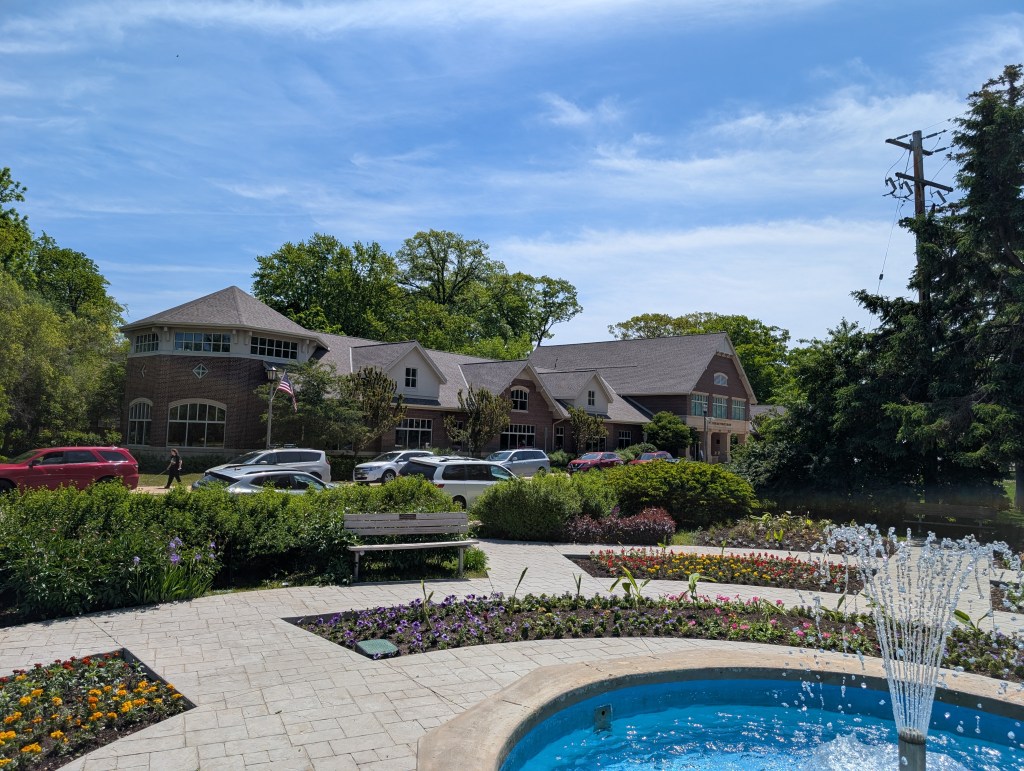
    Recently, Library Director Nyama Reed and Library Board Member Nikki DeGuire presented the Public Library’s 2026-2030 Strategic Plan to the Village Board. One main takeaway: the library is exceptionally good at what it does, and that excellence may be starting to strain the seams.

    The Whitefish Bay Library is a community institution that is, by nearly every available metric, outperforming its peers and doing so with a staff that is working, in the Director’s own words, past its capacity.

    By the Numbers: A Well-Used Library

    The statistics should make any community member proud. While the state average for library card holders is 22% of residents, 46% of Whitefish Bay residents hold an active card. The library averaged 500 visitors per day in 2025. That works out to 11 visits per resident annually, nearly double the Milwaukee County Federated Library System (MCFLS) average of six. It ranks as the most visited library per resident within the MCFLS, and a vendor the library previously worked with told them they had the highest patron engagement rate of any library, suburban, rural, or urban, that the vendor had encountered nationwide.

    Library Visitors from the Library Board Meeting Agenda April 2026

    With one of the highest percentages of residents under 18 years of age of any municipality in Wisconsin, it may not be surprising that the library circulates more children’s material than any other library in Milwaukee County and ranks among the top five in the state. 

    The Whitefish Bay Library also holds the distinction of having the third-lowest cost per circulation of any library in Wisconsin. This is a strong nod to yet another institution in the Village that operates at an efficient use of taxpayer dollars when compared to peers.

    An impressive 37% of the library’s circulation now comes from non-residents, up from 31% just a year ago, which generates additional revenue through the MCFLS’s member reserve fund. That jump is partly explained by the fact that neighboring libraries, including North Shore and Brown Deer, have reduced hours significantly to manage their own budgets, closing on Sundays year-round.

    The Flip Side: Understaffed for the Demand

    The challenge embedded in all of this success is a staffing gap that the data makes hard to ignore. Using MCFLS benchmarks and adjusting for usage levels, Reed shared that when comparing items circulated by the library to staff, the Whitefish Bay Library circulates 60% more material per staff member than peer libraries. She calculated that if the library was staffed at the same rate as peer libraries, there would theoretically be 17 full-time equivalent staff members compared with the current 11.

    Library Circulation from the Library Board Meeting Agenda April 2026

    A staff survey conducted as part of the planning process reflected a team that genuinely loves its work and takes pride in the library’s community role, but surfaced real frustration: a reliance on part-time positions and where turnover can be a chronic problem.

    The practical effect of the current set up is that department heads spend significant time on operational and administrative duties, covering desks, training new hires and filling gaps, rather than on strategic and program work that the library’s patrons may actually desire. 

    What Patrons Are Asking For

    A recent library community survey drew 803 respondents and the feedback was overwhelmingly positive: 97% of open-ended responses were positive or constructive. The top requests from residents were shorter wait times for popular titles, more study rooms, and more digital and physical formats.

    The study room demand is real and growing. The library frequently maintains a waitlist for study rooms, particularly after school. High schoolers working on group projects, tutors meeting with students, adults needing a quiet space for a job interview or a focused work session – demand consistently exceeds supply. The library has identified a potential solution: converting staff offices behind the reference desk into study rooms (which may yield three to five additional rooms), and relocating staff workspace to what is currently an underutilized back-processing area.

    Interestingly, 19% of survey respondents expressed interest in non-English materials, particularly German and Spanish.

    Facilities: Beautiful, Well-Loved, and Starting to Show Its Age

    The library building’s front doors have opened more than eight million times in the past 24 years as estimated by Reed, dating back to the remodel completed in 2002. The building is in good structural shape thanks to a few recent village investments: a new roof, fire suppression upgrades, an upcoming boiler replacement, and the solar panel installation recently completed. But interior needs have accumulated. Reed shared the most pressing: the additional study rooms discussed above, improved private workspace for staff (the current staff offices have no doors, making focused work nearly impossible), and a second-floor public restroom. Currently, the only restroom on the second floor is a staff-only facility accessible through the break room.

    The Path Forward 

    The numbers tell a clear story: Whitefish Bay residents love their books and seemingly are getting exceptional value from their public library. The strategic plan ahead is about making sure the institution can keep delivering on that promise for the next generation and beyond.

  • Whitefish Bay Proposes Significant Increase in Water Utility Rates. Here’s the Full Picture.

    Whitefish Bay Proposes Significant Increase in Water Utility Rates. Here’s the Full Picture.

    The village is moving forward with a formal rate case application to the Wisconsin Public Service Commission that would raise water utility base rates by 28%. While that number may raise eyebrows, the reasons behind it have been building for years.

    The last conventional rate case for the village was filed in 2020, resulting in a 15.5% increase. Since then, water rates have barely moved — just a 3% inflationary adjustment in December 2025. Six years of inflation (particularly high inflation at that), aging infrastructure, and a major federal mandate have quietly piled up, and the 28% figure is largely the catch-up cost.

    The Big Driver: Lead Service Line and Water Main Replacement. 

    The EPA now requires water systems across the country to replace all lead service lines by 2037. The village’s 2026-2031 Capital Improvement Plan includes replacing one mile of aging water main and associated lead service lines every year. That’s a significant, decade-long capital commitment and it’s a major factor in why rates will need to rise now and potentially again in the future. Projections already anticipate another significant conventional rate case around 2030.

    The village side of the service line replacement (from the water main to the curb stop) will be paid for by the water utility through debt issuances. The private side, from the curb stop to the home, will be the homeowner’s responsibility, with costs estimated at roughly $8,000 per line – a separate line item from the rate approval mentioned above. There has been discussion of allowing residents to space out payments over a few years versus a one time special assessment payment.

    For the average residential customer, the rate increase translates to roughly $91.74 more per year. Even after the increase, the village’s rates would sit in the middle of the pack compared to other Milwaukee County utilities, many of which are seeing similar impacts. Shorewood, similar in size and with a comparable historical infrastructure profile as Whitefish Bay, anticipates an increase of more than 50% on the average residential customer water utility bill over the next two years relative to 2025 bills. 

    The village plans to file the application by May, with new rates potentially in place by year’s end.