Whitefish Bay and Shorewood sit side by side in the North Shore. Similar in physical size, population, and aging infrastructure issues and historically both regarded as among the strongest school districts in Wisconsin. But in 2026, the two communities are navigating strikingly different challenges when it comes to their schools. One is wrestling with what to build. The other is wrestling with what to close.
Shorewood resident Brian Stoffel recently posted a video in local Facebook groups to raise awareness and explain the complexities at play within Shorewood’s school system. I was able to connect with Brian to learn more about what is happening in Shorewood with a potential closing of the Shorewood Intermediate School and how it may or may not be relevant to the conversation in Whitefish Bay (hint, it’s probably less relevant than some may hope).
First, an Overview of The Communities Behind the Districts
The demographic differences between the two villages are modest but meaningful when it comes to school enrollment.
Whitefish Bay, with a 2025 population of 14,489, skews young: 31% of residents are under 18 years of age (well above the national average of 21.5%) and only 14% are 65 or older according to the US Census Bureau.
Shorewood, at 13,474 residents, looks quite different. Only 19% of the population is under 18, below the national average, and 17% are 65 or older.
Whitefish Bay’s district enrolled 2,861 students in 2024-25 or 49% more than Shorewood’s 1,916. But the headline enrollment numbers don’t fully capture either district’s situation.
As was laid out in Whitefish Bay School District’s Community Change & Student Enrollment Projections Report last year, overall enrollment has declined about 8% over the past decade. Two-thirds of that decline is attributable to the wind-down of the Chapter 220 integration program: as of 2024, only 37 Chapter 220 students remain, down from higher levels earlier in the decade. Non-220 open enrollment also dropped from 59 students to zero. Strip those program changes out, and Whitefish Bay’s enrollment of district-resident students has declined by less than 1%, a remarkably stable local base.
Last year’s report concluded a projected decrease of 128 students between 2024 and 2040. With almost two years of look-back on that report at our disposal today, it should be noted that attendance so far has gone the other direction from the report’s predictions. At the start of this school year, attendance increased to 2,878 and the district’s enrollment in January jumped to 2,896, which is a 113 student difference compared to the projected trend in the report of 2,783 for the 2026-27 school year.
As Brian shared with me, Shorewood tells a different story. The district’s enrollment has seen a steady decline over the past 10 years with a recent peak in the 2016-17 school year at 2,163 students. Enrollment has declined since, with a notable drop around 2019-20. The district currently sits at 1,916 students, down 11% from that peak, and unlike Whitefish Bay, the drop reflects broader demographic shifts rather than program changes. The Shorewood district has been working to align staffing levels with enrollment trends to maintain financial stability.
Buildings, Space, and the Utilization Question
This is where Brian and I noted the two districts’ situations diverge most sharply and where the comparison gets most instructive.
Whitefish Bay operates four active school buildings (Richards, Cumberland, the Middle School, and the High School) plus the Lydell Community Center, totaling 660,000 square feet on nearly 40 acres. Not including Lydell, the district has 638,335 square feet across 34 acres. With 2,861 students, that works out to roughly 223 square feet per student.
Shorewood operates four school buildings (Atwater Elementary, Lake Bluff Elementary, Shorewood Intermediate School, and the High School) totaling 516,575 square feet. With 1,916 students, Shorewood has about 270 square feet per student or 20% more space per student than Whitefish Bay.
One wrinkle Brian felt it worth noting when comparing available square footage of the facilities: Shorewood High School was designed more like a college campus than a traditional school, with non-connected buildings spread across the grounds. That makes the district’s total square footage figures somewhat hard to interpret, though it likely undercounts the true square footage in comparison to Whitefish Bay’s.
Shorewood Intermediate School currently serves approximately 300 students in grades 7 and 8. Brian explained that under the consolidation scenario being considered, those students could move to the high school campus, though key details haven’t been released yet. It’s still unclear exactly how the set up may work. For example, Brian suggested that the 7th and 8th graders might still be able to use the SIS cafeteria or the middle school athletic teams may continue to use the SIS gym even after the building otherwise closes.

Spending: Whitefish Bay Does More With Less Per Student
The financial comparison between the two districts is striking as well. Both districts had similar total revenues in 2022-23 (the most recent available from the National Center for Education Statistics in the US Department of Education): Whitefish Bay at $46.2 million, Shorewood at $41.3 million. But because Whitefish Bay serves 49% more students, its per-pupil cost is substantially lower, spending $8k/student less or a whopping difference of 36%.
| WFB | Shorewood | |
| Total Revenue (’22-’23) | $46.2M | $41.3M |
| Revenue per Student | $16k | $21k |
| Total Spending (’22-’23) | $40.8M | $42.8M |
| Spending per Student | $14k | $22k |
| Total Students (’24-’25) | 2,861 | 1,916 |
| Teachers (FTE ’24-’25) | 179 | 131.2 |
| Student/Teacher Ratio | 16:1 | 15:1 |
The income gap between the two communities adds important context. Whitefish Bay’s median household income of $157,109 is nearly double Shorewood’s $86,726 (US Census Bureau). Combined with Whitefish Bay’s significantly lower per-student spending, the two districts are operating with very different relationships between what they spend and what their residents can bear, a gap that shapes every conversation about referendums, tax levies, and facilities investment.
Shorewood’s Budget Pressure
Shorewood currently relies on an operating referendum, approved by voters in 2023, that allows the district to levy an extra $5.5 million per year beyond the state formula. That referendum runs through approximately 2028. As Brian states it, the challenge is that even if the district comes back to voters asking to continue at the same $5.5 million level, the projected need by 2028 is closer to $7.5 million annually. That’s a roughly $2 million structural gap, driven primarily by salaries increasing roughly 3% per year and health insurance costs rising as much as 10% annually, all while enrollment is flat or declining.
Closing SIS, according to the district’s long-term sustainability task force, could save $1 to $1.5 million per year by eliminating duplicated administrative roles and reducing facilities operating costs across one fewer building. That’s a significant chunk of the gap, though by itself doesn’t close it entirely.
Brian makes one observation that lands with particular force: Whitefish Bay spends less on average teacher pay and if Shorewood paid its teachers at the same average rate as Whitefish Bay, the savings would make a substantial dent in the district’s budget shortfall if not even eliminate it. His broader takeaway is that Whitefish Bay, on a per-student basis, is running an unusually efficient operation and that efficiency gap is a big part of why the solutions that make sense for Shorewood won’t translate across the village line.
Two Different Problems, One Shared Lesson
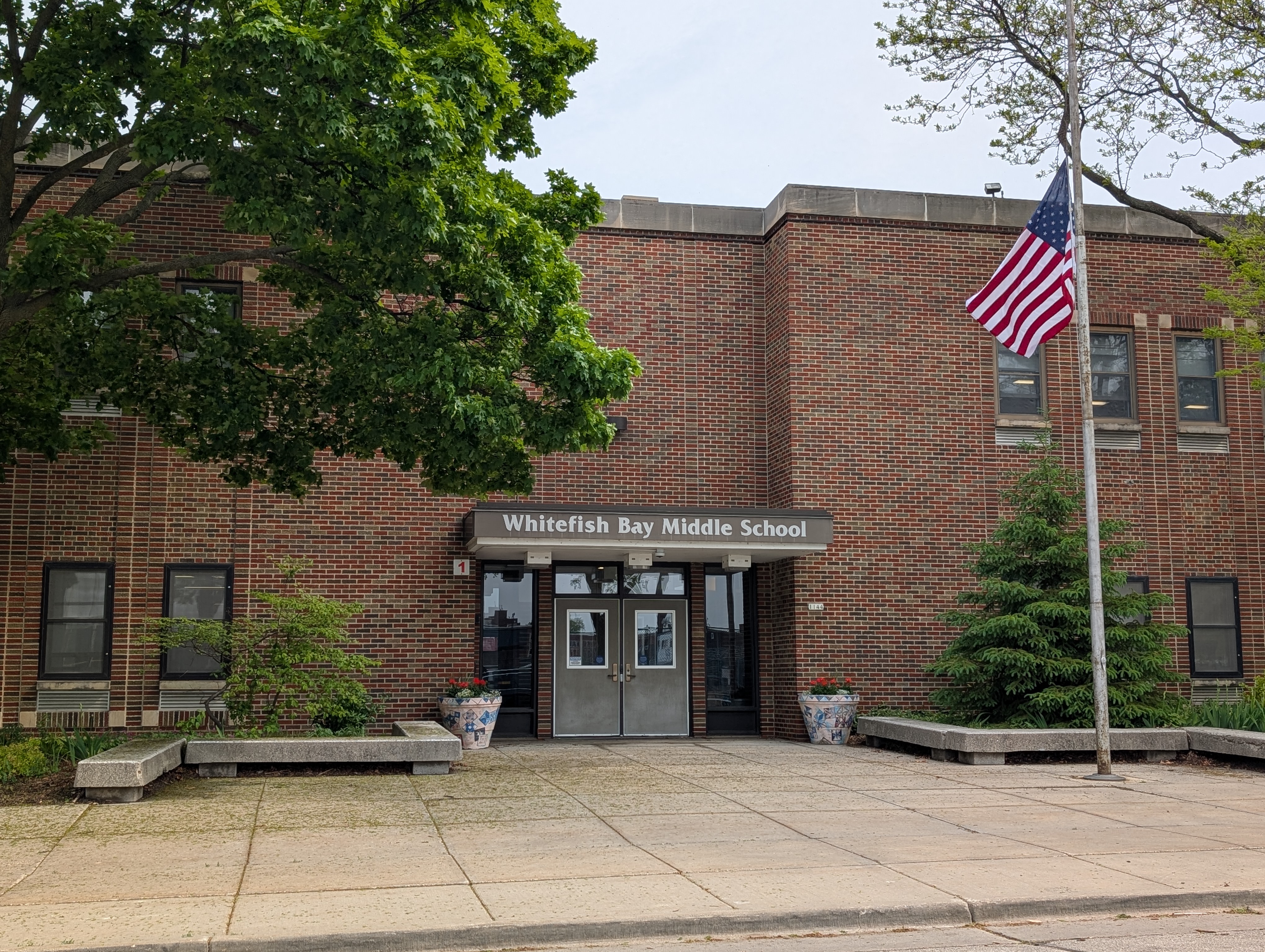
Whitefish Bay’s challenge is a building problem: its middle school is at 94% capacity in facilities that are aging and increasingly inadequate, and the district is trying to figure out whether to renovate or build new, a question that involves significant community investment either way. The Whitefish Bay School Board is now embarking on a summer community engagement process before deciding whether to return to voters in November 2026.
Shorewood’s challenge is an enrollment-and-capacity problem on top of an operational budget deficit: too much building for too few students, with budget pressure forcing difficult staffing decisions. Considering closing the Intermediate School building and moving 7th and 8th graders to the high school campus may be a logical response to those realities — but it comes with real disruption to a roughly 300-student community that, by most academic measures, is functioning well, and where students currently enjoy a distinct middle school experience that would look quite different inside a high school building.
Brian, whose video series on Shorewood’s school district challenges was the genesis of this comparison, puts it well: the two districts may be neighbors, but their problems are fundamentally different in kind. Borrowing solutions across that divide is unlikely to serve either community well. The value of the comparison isn’t to suggest one district should follow the other’s lead — it’s to understand that the right answer for each will need to be shaped by its own demographics, finances, and community values.
Neither problem is easy. And residents of both communities are paying close attention.
Leave a Reply