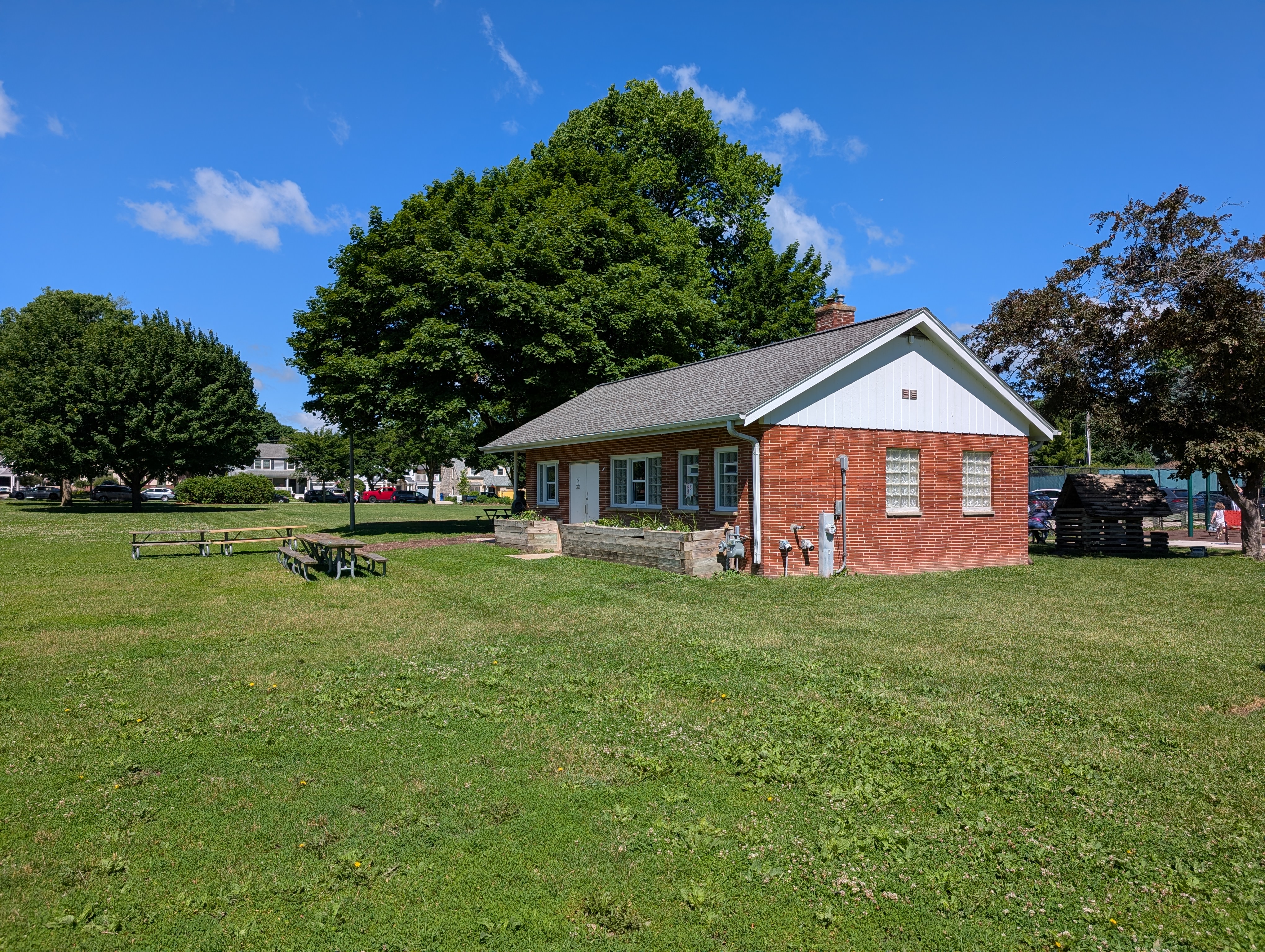
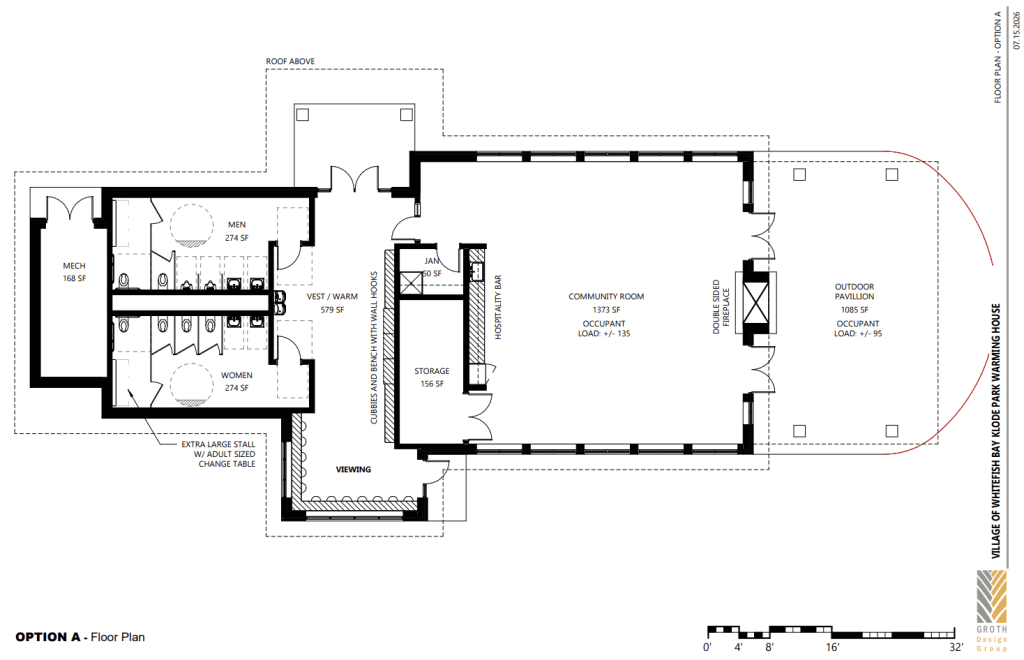
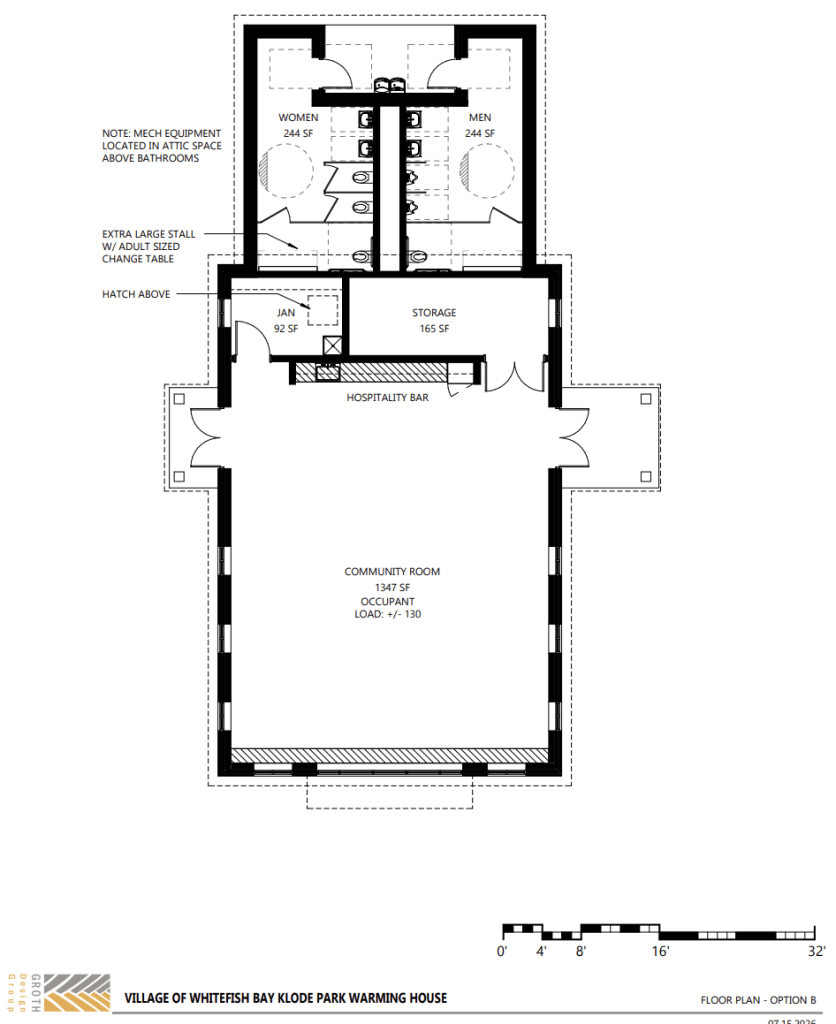
Klode Park warming house: First look at initial designs below. Concepts will be refined before a public survey will be released for residents’ feedback.
Elmbrook’s $100M referendum: District approves a facilities referendum question for November’s ballot to update and expand four aging schools from the ’50s and ’60s.
The Village Board got a first look at draft concepts for the rebuilding of the Klode Park warming house. Here’s the rundown, plus another item worth your attention.
Klode Park Warming House: Three Initial Concepts
The village recently appropriated $1.5 million to replace the aging Klode Park warming house, and earlier this year approved a contract with the GROTH Design Group to lead the design and construction. Since then, GROTH has held two open houses as well as sessions with the Civic Foundation and Business Improvement District to gather early input. Monday’s presentation to the board was the next step: three initial design concepts, aimed not at picking a “winner” but at discussing feedback to narrow the field before taking something to a broader community survey.
Scroll the images below to see each version presented:
After a detailed back-and-forth discussion, covering everything from mechanical room placement, to where a band should face during a concert, to whether large windows make a rented space feel too “exposed” for something like a funeral reception, the board converged on a few takeaways, including:
Bathrooms should be accessible from both indoors and outdoors
The building needs to look good from all sides, particularly the Lake Drive-facing side, since that will be how most Villagers will see it day to day
The board would like a standalone, detached pavilion/band shell (directing music toward the lake) in addition to an attached covered overhang or patio on the main building itself
Architectural details may be added to make the building reflect similar architecture found in the Village.
Residents like the fireplace at Cahill – keep that in this design.
The tentative plan going forward appeared to be to develop two refined concepts using the feedback provided.
No formal vote was needed Monday as this was a discussion item to guide next steps. Look for the refined concepts and a public survey in the coming weeks.
The anticipated construction schedule estimates that the warming house will be completed before the end of 2027.
Elsewhere in Wisconsin: Elmbrook Puts $100M Referendum on the Ballot
For anyone tracking how other Wisconsin districts are navigating the same facilities-and-referendum landscape that Whitefish Bay is working through, the Elmbrook School Board voted this month to put a $100 million facilities referendum on the November ballot. Like Whitefish Bay, the Elmbrook district is high performing and shares many demographic/median income similarities. It encompasses Brookfield, Elm Grove and parts of New Berlin. This will be the district’s first referendum since 2008, when voters passed a $62 million referendum. The Journal Sentinel covered the story here.
The package would fund infrastructure upgrades and ADA improvements at four aging schools built between 1958 and 1969, plus building additions at two of them. It pairs with a separate $71 million in planned facilities/maintenance spending funded through the district’s regular operating budget over the next decade.
If approved, the district shared that the tax impact would be a modest increase of about $66 more per year for the owner of a $600,000 home. The Elmbrook School district encompasses a much larger population and tax base than Whitefish Bay’s. The district serves over 7,800 students at 10 schools relative to Whitefish Bay’s more than 2,800 students across four schools.
The Elmbrook district’s 20 year facilities plan can be found here. Warning, they use BoardDocs too!
Mill Rates per $1,000 of assessed home value for Milwaukee area School Districts in the 2025-2026 school year. From Wisconsin DPI’s School Finance Maps
Middle school options: A new option would build the school on Armory Park around the Veterans Monument, leaving it untouched, for $67.3M. No debate on which option being considered is preferred yet.
Class sizes: With some sections projected at nearly 27 kids, the board directed administration to post for one additional upper-grade elementary teacher.
This week’s board meeting was anything but just a summer placeholder. Over roughly three hours, the board got its first look at a brand-new middle school site option that keeps the Veterans Monument and Memorial Garden exactly where it is, heard a status update on the community survey and had a candid debate about elementary class sizes.
A potential new wrinkle: build around the memorial
The headline document of the night was a fourth middle school option: build the new school on Armory Park, but notch the building around the existing Veterans Monument so it never moves. Architect Nick Kent walked the board through the current options being considered.
The district provided four updated cost summaries for the middle school:
Option 1— Maintenance only: $21.04 million. Fixes the documented maintenance list but the layout stays exactly as-is and extends the life of the old building. Complete summer 2030.
Option 2 — New building on Armory Park (last April’s ballot question): $67.7 million. Requires relocating the memorial and green space, tennis courts, and a parking lot. Complete fall 2029.
Option 3— Renovate and expand in place: $67.8 million. A three-year, four-phase “full gut” that keeps students on site the entire time. Complete spring 2031.
Option 4— New building, memorial untouched: $67.3 million. The building shifts south, the memorial stays put, and the school wraps around it. Complete fall 2029.
Click the underlined options above for more granular details from the school district (loaded to Dropbox)
The tradeoff on Option 4 is the lacrosse field. Pushing the building south shrinks the practice field below regulation dimensions for lacrosse and soccer, meaning competitions would move to the stadium complex creating more scheduling pressure there. It also requires a retaining wall near the softball field and additional Village-owned land, and Kent was candid that a three-story building wrapping a memorial raises a question: how close can you build “and maintain the dignity of that site”?
Kent was equally candid about what renovate-in-place actually means. It is not patching what’s broken — it’s stripping the building to its bones while roughly 600 students remain on site. Ten temporary classrooms in the gymnasiums, no functioning gym for up to three years, no library for a stretch, reduced outdoor play space, and a likely closure of Henry Clay Street for staging.
The board was explicit that no decision was being made Tuesday — these are “data points,” not finalists.
The community survey is ongoing
The Donovan Group reported that more than 1,000 survey responses have come in thus far as of Tuesday evening, well past the firm’s minimum target, though the board is hoping for many more responses. The survey stays open through July 31st, with a full report to the board targeted for mid-August. Don’t forget to take the survey if you haven’t already! It can be accessed here.
Class sizes
This past school year, there was a vocal cohort of parents who were not pleased with class sizes at the elementary schools. The board discussed the potential for adding sections to alleviate the class size issue. Current projections put Cumberland’s 3rd grade and Richards’ 5th grade at an average of 26.75 students per section, with Cumberland 5th grade at 26. The Administration shared that adding a section costs roughly $142,000–$146,000 once you count the teacher, Encore minutes (art, music, PE, Spanish), Chromebooks, and furniture.
Board members invoked the district’s own staffing plan, which cites a historical class-size range of 21–26 — and several were blunt that 27 kids in an elementary room isn’t consistent with what this community expects. After polling the table (four in favor, two neutral), the board directed administration to post for one additional upper-grade elementary teacher, deliberately not pinned to a specific grade or building yet, so enrollment can shake out over the next few weeks. The budget already carried a placeholder for one section, so this doesn’t create a deficit.
One more month. The board has to settle a November referendum question by the end of August.
While most Wisconsin school districts are bracing for a reduction in state aid next year, Whitefish Bay is among the minority that will likely see an increase, a meaningful piece of context as the district prepares to ask voters for a new facilities referendum this fall.
The Wisconsin Department of Public Instruction released its preliminary general aid estimates last week for the 2026-27 school year. As reported by WPR, the headline statewide: about 60% of Wisconsin’s 421 public school districts will see state aid decrease, with 92 districts hitting the maximum allowable reduction of 15%. Only 38% of districts will see an increase, Whitefish Bay among them, while a handful expect no change.
What It Means for Whitefish Bay
Whitefish Bay’s general aid from the state is projected to increase by $320,761 — a 2.07% gain, rising from $15,487,946 in 2025-26 to $15,808,707 in 2026-27.
The WFB Buzz reached out to Ben Irwin, the district’s Director of Business Services, who confirmed the numbers and provided a more precise breakdown. The 2026-27 estimate of $15,808,707 consists of $15,495,806 in Equalization Aid plus $312,901 in Special Adjustment Aid tied to the Chapter 220 program. The prior year’s total of $15,487,946 broke down as $15,056,426 in Equalization Aid plus $432,520 in Chapter 220 Special Adjustment Aid. Irwin noted the district also receives state aid from other sources (Special Education Aid and Per Pupil Aid among them) but Equalization Aid is the largest single source of state revenue the district receives each year.
That’s welcome news, but it’s important to understand what state aid figures actually mean. As Irwin put it: Equalization Aid “will not impact how much total revenue we have to work with within our budget since Equalization Aid is balanced out with the tax levy within the Revenue Limit.” Sara Shaw, deputy research director at the Wisconsin Policy Forum, made the same point to Wisconsin Public Radio: a change in state aid doesn’t change how much a district can spend — it changes where that money comes from. If state aid goes up, property tax levy needs go down proportionally. If state aid goes down, property taxes fill the gap.
In other words, a $320,761 increase in state aid is effectively a reduction in pressure on Whitefish Bay property taxpayers — a modest but real benefit heading into a year when the district is also likely to ask voters to approve a significant capital referendum.
It’s also worth noting that overall state general school aid remains flat statewide for the third consecutive year at $5.58 billion. Factors often cited in the broader debate include declining statewide enrollment as birth rates have fallen and a growing shift of funding toward voucher programs. Notably, the state’s most recent budget did include a $1.4 billion increase for K-12, but directed it toward special education reimbursement rather than general aid. “Membership”, as the DPI reports enrollment, is down 1.9% across the state using January 2025 numbers compared to January 2026. Whitefish Bay’s membership increased in this same time period from 2796 to 2838 according to the data.
The stakes of school aid trajectory are not lost on village leadership. Village President Kevin Buckley commented to the Buzz: “When asked by state officials to name the biggest issue facing our village, my answer is school funding. That might be an abdication of my municipal duty, but it is the honest reality for us and communities across Wisconsin.”
How Neighboring Districts Fared
The results among nearby districts were mixed:
District
2026-27 Aid (Estimated)
2025-26 Aid (Final)
Change
% Change
Whitefish Bay
$15,808,707
$15,487,946
$320,761
+2.07%
Shorewood
$7,044,641
$6,713,401
$331,240
+4.93%
Glendale-River Hills
$2,028,441
$1,910,687
$117,754
+6.16%
Nicolet UHS
$737,996
$826,099
-$88,103
-10.66%
Fox Point J2
$1,432,138
$1,684,868
-$252,730
-15.00%
Maple Dale-Indian Hill
$73,571
$86,554
-$12,983
-15.00%
July Estimates Can Move
These are preliminary July 1 estimates — the figures are finalized each October, and the gap between the two can be significant. Last year’s July estimate for Whitefish Bay was roughly $16.1 million; the certified October number came in nearly $600,000 lower.
Irwin explained why: the July 1 estimate is based on budget data, while the October certification is based on actual fiscal activity and the district anticipated that drop. He added that the DPI has moved to a new fiscal reporting format allowing districts to submit budget data more regularly, which he expects will narrow the July-to-October gap going forward.
There’s also a factor entirely outside the district’s control: spending trends at other districts across the state affect how the aid formula distributes the fixed statewide pot. “It is not a perfect science, but we do our best to maximize state aid for Whitefish Bay in order to minimize the tax burden on the community,” Irwin said. He noted that Whitefish Bay sits “right on the edge” of the formula’s shared-cost scenarios, so the district monitors spending habits and statewide trends closely.
One concrete example of that active management: Irwin confirmed that the district’s recent early payoff of its remaining debt obligations — covered by WFBBuzz in May — was done in part to try and take advantage of this formula and get the district more aid this fall.
Before diving into today’s post, please take the time to fill out the School Board’s Survey, which is now live through the end of July – dgsurveys.com/r/WhitefishBay2026. While the prior survey was physically mailed to households in the district, this edition of the survey is online. Paper copies can be obtained by emailing districtnews@wfbschools.com
The Whitefish Bay School Board is once again weighing whether to renovate or build a new middle school, likely at the Armory Park site. It’s the most ambitious version of an idea the community has wrestled with for nearly four decades. The building at 1144 E. Henry Clay St., which originally opened in 1919, was too small from the day it reopened as a school in 1989, and the district has spent the better part of the past forty years patching, expanding, studying, voting, and debating about what to do next.
Here’s how we got here.
1988: Converting Henry Clay into the Middle School
The recent middle school debate didn’t begin with a new building. It began with an old one.
In early 1988, Superintendent LeRoy Rieck proposed converting the Henry Clay Community Education Center — the former Henry Clay School that had been repurposed as a community hub in 1980 — into a middle school for grades 6 through 8. Cumberland and Richards would become K-5 schools. The estimated savings: $250,000 a year (almost $750,000 in 2026 dollars) from consolidating specialty teachers who then traveled between buildings.
The plan immediately stirred controversy. Senior citizens, as well as others, had come to rely on Henry Clay for meetings, lunch programs, social activities and rec department and MATC classes. They showed up to meetings in force to oppose it. Lydell Elementary (at the time holding K-2nd grade) parents circulated a 539-signature petition. Some residents questioned whether the building was even large enough to support a real middle school program.
The school board voted unanimously to approve the plan anyway at a June 1988 meeting before an audience of more than 500, with a cheer erupting in the high school auditorium when the result was announced. The vote among the crowd had been 315 to 216 — far from unanimous, noted Board President Carolyn Wilson, who acknowledged that “clearly, there are people who are not happy with the decision.”
Financing was cobbled together to convert Henry Clay and Lydell for their future uses: $1 million from the district’s operating reserves and a $750,000 loan from the State Trust Fund. Total renovation cost was estimated at $1.75 million (roughly $5 million in 2026 dollars), with a new gymnasium addition at Henry Clay accounting for $640,000 of that total.
The gym addition was pilloried by neighbors who compared the bare brick wall to the Berlin Wall.
The Armory, still standing and in use at the time, was located on the same block as the middle school and allowed the school district to use a 10-foot strip of its property for a new parking lot at the time in exchange for the district paying for its construction. Even in 1989, the Armory and the middle school were neighbors making arrangements with one another.
The Whitefish Bay Middle School opened in August 1989 with approximately 500 students (this past school year that number was 608). Within two years, it was straining at the seams.
By March 1991, the school board approved $100,000 to carve three additional classrooms out of the old gymnasium stage and basement space. Some board members were already uncomfortable. “These classrooms won’t have windows,” said board member Ruth Derse. “No one will want to be in them.”
The school’s enrollment was growing, and the building was simply not built for what was being asked of it.
From the Mimi Bird Collection at the WFB Library. Middle School Gym addition shown in the bottom photo. If you squint you can see the original structure behind a front addition in the top photo.
1994: The First Failed Referendum
By early 1994, the Middle School Study Commission, a group of parents, teachers, and elected officials, had studied 31 options and recommended a $4.4 million expansion ($10 million in 2026 dollars). Enrollment at the time was 581, against a designed capacity of 600, with projections showing 700-plus students by 1999. Some classrooms already had 31 students, violating the district’s own policy of 23 to 25.
The board also weighed a more dramatic option: building a brand new school, either at Cahill Square or on the old Lydell School site. That would cost roughly $10.3 million. The board rejected the new school idea in February 1994 and voted 4-3 to put the $4.37 million renovation on the May ballot.
The board was bitterly divided. Three dissenters said they would neither campaign for it nor against it. The Whitefish Bay Taxpayers Association ran a vigorous opposition campaign, arguing the plan was too expensive, the building was too old to justify the investment, and finally (this will sound familiar!) that the Armory property — which the Wisconsin National Guard was expected to vacate in the coming years — should be considered as a site for a new school before the district committed to patching the old one.
Voters rejected the referendum in May 1994 by a vote of 1,975 to 1,366. 33% of eligible voters voted in that referendum versus the 70% of eligible Villagers who voted in April 2026 (Way to go today’s voters!)
In the aftermath, the board floated alternatives: moving eighth graders to the high school (dismissed as educationally damaging and logistically impossible — the high school lacked adequate science and computer labs, and the eighth graders would need different schedules and start times), or physically swapping the middle school and high school buildings entirely (administrators called this workable only as a temporary measure). The middle school concept itself was briefly questioned.
1995: Second Try Barely Passes
On its second attempt, the district came back with a refined plan the following April. The new proposal called for a two-story, 26,000-square-foot addition to the east end of the middle school building, adding 28 rooms including 13 classrooms and six science labs, widening hallways, upgrading electrical, plumbing, and mechanical systems, relocating the school office closer to the entrance, enlarging the cafeteria, and expanding the media center. Total cost: $4.9 million ($10.8 million in 2026 dollars), with $890,000 coming from district reserves and $3.9 million in borrowing, if approved by voters on April 4, 1995.
The Taxpayers Association again campaigned against it, accusing the board of “theatrics and emotions” and calling the renovation “shortsighted” given that the Armory property might soon be available. “Explain a school board which knowingly rushes into an irrevocable multi-million dollar project without possessing all the facts regarding the loss of substantial future state aids,” their Vote No statement read.
Advocates for Education, a citizens group that had formed after the May 1994 defeat, pushed back hard. “A new school, perhaps at a cost of $12 million or $15 million, is not economically feasible at the armory or any other site,” their Vote Yes statement said. “There will be no new school or third referendum attempt a year from now if the community votes ‘no’ Tuesday. There will simply be an unmet educational need in our community.”
Voters approved the referendum on April 4, 1995 — by 2,980 to 2,898. Fewer than 100 votes separated the two sides.
2009 Referendum
The 2009 referendum included two questions that ultimately passed. The first asked for $9 million for maintenance and renovation funds to be used across all school facilities in the district. The second question asked for $13.6 million to mainly fund additions to the High School, Richards and Cumberland. The Middle School received a new gym floor as well as a relocation of the orchestra room from the basement from the 2009 referendum.
Now: A New School, The Same Debate
Thirty years later, the building at 1144 E. Henry Clay St. is again at the center of a community debate. The district’s Facilities Advisory Committee spent years studying all of the district’s buildings and concluded that the middle school, now 107 years old, with additions dating from the 1930s, 1950s, and 1980s, as well as the 1990s expansion voters barely approved, has reached the end of its useful life for modern education. The April 2026 referendum asked voters to approve a package that included a new middle school at Armory Park, at a cost of $67.7 million. It failed, 52% to 48%.
The board is now gathering community feedback through focus groups (June 16 and July 14) and a community survey before deciding in August whether to put a revised question on the November 2026 ballot.
The parallels to the 1990s are striking. Then as now, the community was divided between those who wanted to renovate and expand what exists and those who argued that investing in a century-old building is throwing good money after bad. Then as now, cost was a central objection. And then as now, the Armory property was identified by some as the right place to build something new and by others as a complicating factor that the board was moving too fast to properly consider.
There are also differences. The 1994-95 debate was primarily about whether to expand a school that was overcrowded with students. Today’s debate is about whether to replace a building that is aging out of functionality — mechanically, structurally, and educationally — while enrollment stays steady. The dollar figures have grown by an order of magnitude. And the community now has thirty more years of experience with what the current building can and cannot do.
The board has been careful to say that the needs identified in April haven’t changed. What they’re trying to figure out is how to build the community trust that would make acting on those needs possible.
In 1988, a board member quoted a philosopher’s advice to the school board: “If you wait until you have all the information to make the decision, it’s clearly too late to make the decision.” The board moved forward at that time. Whether Whitefish Bay is ready to move forward now, and on what terms, is the question the focus groups and community surveys are designed to help answer.
As mentioned in the above images, this post references a number of articles from the Mimi Bird Collection at the WFB Library in addition to other articles pulled from the Journal Sentinel’s archives.
As the class of 2026 has now officially graduated and they head off to college this fall, a remarkable number of Whitefish Bay student-athletes will be trading Blue Duke uniforms for college ones. Building on the tradition highlighted in our earlier look at current D1 athletes, here’s a look at the incoming college athletes from WFB, from Power Five programs to storied D3 institutions.
As with the last time, this list is a best effort and may not capture everyone. All of the below information was pulled from public resources, namely Instagram (my wife points out that I am the last 30-something on the planet to finally sign up for Instagram so that I could research this post).
NCAA Division I
Sage Miskel — Women’s Basketball, Butler Bulldogs Miskel joins Butler’s women’s basketball program this fall, where her father Chris Miskel played. On the court, she helped lead the team to a D2 state title and earned WBCA All-State and co-Conference Player of the Year honors.
Anne Dickinson — Women’s Swimming & Diving, Indiana Hoosiers Dickinson moves on to Indiana this fall as one of the most decorated swimmers in WFB history. She finished her high school career with 10 total individual state championships and helped lead the team to two state championships.
Clare Schaefer — Women’s Tennis, Butler Bulldogs Schaefer heads to Butler this fall to join the women’s tennis program. A standout at WFB and one of the North Shore Conference’s top players this fall. She came in 4th place in the state for doubles her senior year and won a singles state championship her junior year.
Charlie McIntyre — Baseball, Youngstown State Penguins McIntyre heads to Youngstown State this fall as a two-time All-State and three-time All-District selection. As co-Conference Player of the Year, he led the team to a co-Conference Championship. He was a member of the state championship 2023 team.
Fischer Jakowski — Men’s Swimming & Diving, Saint Louis Billikens Jakowski ships out to Saint Louis University’s program this fall. A key contributor to WFB’s state championship boys swimming program, was a three-time All-State swimmer his senior year and holds multiple school records.
Tosin Kolawole — Football, U.S. Air Force Academy Falcons A standout who played LB and RB for the Blue Dukes, Kolawole was one of the most impactful players on WFB’s 2025 Cinderella story team, reaching the WIAA Division 3 state semifinals.
Kate Hunter — Rowing, Wisconsin Badgers
Finley Jorgensen — Rowing, Wisconsin Badgers
Photo courtesy of @WFB_BlueDukes X Account
Committed for 2027-28
Chase Wolter — Baseball, UIC Flames (WFB Class of 2027)
Aibhy King — Women’s Swimming & Diving, Georgia Tech Yellow Jackets (WFB Class of 2027)
Madonna Helf — Women’s Soccer, Wisconsin Badgers (WFB Class of 2027)