

Note: As with all of my school board recaps, the below should be considered my personal observations from watching last night’s meeting.
Key Takeaways:
- The board reviewed a middle school renovation/rebuild in place option that removes a few of the less desirable aspects of the first renovation option.
- The potential referendum ask drops to roughly $90 million, down from April’s $135.6 million. Estimated tax impact: $125 per $100,000 of assessed value.
While nothing is set in stone — that should happen at next week’s school board meeting — it appears the board has landed on a path for November’s referendum. At Wednesday night’s meeting, members were presented with a newly reworked plan to renovate the middle school in place, and it drew broad support around the table. The likely ask: approximately $90 million.
No formal vote was taken. But Superintendent Dr. Jamie Foeckler said he needed only “a head nod” from the board to send language to the district’s attorneys to draft the question that will be placed on the ballot. The binding vote from the board comes August 19th.
The recrafted renovate-in-place option

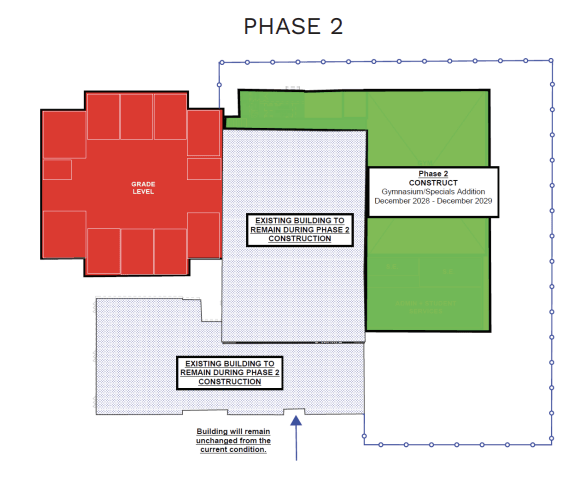


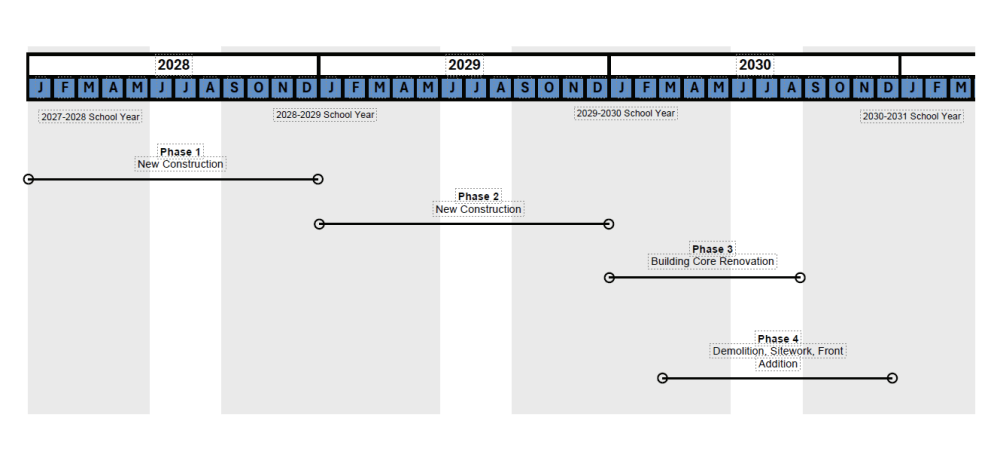

The board was presented with the updated option that would flip the current layout, allowing school activities to continue while construction occurs and also alleviating a few of the dealbreaker aspects in the original renovate-in-place plan.
You can view the full memo and option here (link uploaded to Dropbox).
The new classroom wing (three stories, one grade per floor) moves to the west side of the site. The original Henry Clay School core stays in the middle, stripped to its structure and rebuilt. The gymnasium and specials wing go east, where many of the classrooms are now.
That reversal is what lets construction happen without necessitating classrooms in trailers or in the gyms as would have been required in the original renovate-in-place plan. Building of the west wing would come first, then the students would move in, followed by demolishing the old classroom wing and building the new gym space.
The centerpiece is the oldest gym in the district, which becomes a student commons and cafeteria — skylit, with the original proscenium arch preserved and a small platform for assemblies and performances.
Other details worth knowing:
- It is functionally a new school. About 98,000 square feet of new construction, 45,000 of heavy renovation, 55,500 square feet demolished. Roughly 70% new. “We’re calling it a renovation,” C.D. Smith’s Phil Jaskolski said, “but it’s largely a build.”
- The front entrance gets restored with a small addition. The original main floor sits about seven feet above grade, so stairs and a ramp are required — the same accessibility problem the district has been attempting to solve at the elementary schools.
- The gym would be a full two-station gymnasium with two regulation courts.
- Play space shrinks slightly. The footprint of the building grows, so outdoor space moves to the south side of the building and there will be a bit less of it than today. A plaza replaces the current front approach.
Construction would run in four phases over about three years, with a potential Q4 2027 start and completion in spring 2031 for the 2031-32 school year. No temporary classrooms are anticipated in Phases 1 or 2; Phase 3 may require temporary accommodations for some specials and the library. Full gym functionality is expected throughout.
What a $90 million referendum could buy
Three things as it appears, in order of size:
A rebuilt middle school on its current site — $68 million.
A full mechanical system replacement at the high school — $35 million. The boiler has been on the long-range plan for years, and multiple members called it the least controversial item on the list.
Fire protection and fire alarm upgrades at the high school and both elementary buildings — roughly $4 million. Worth noting, since it came up: the district’s fire alarm systems are up to code today. The gap is sprinklers. The buildings don’t have them, and the MPS fire at the Lincoln Avenue School this summer came up more than once.
Add it up and you get $107 million ($90 million referendum plus the $17 million the district is holding in reserves for capital improvements).
Business Services Director Ben Irwin laid out the tax math: a mill rate increase of $1.25 per $1,000 on the current rate of $6.11, or $125 per $100,000 of assessed value. With the average house in the village assessed at $685,800, that would put the annual figure at $857 for the average household holding other assumptions constant (like anticipated interest rates).
What the survey said
Donovan Group’s Tracy Jentz presented results from the July survey. 2,194 respondents weighed in – the presentation can be viewed here and addendum here.
A few key takeaways: 86.8% said April’s tax impact was too high when asked why they thought the referendum failed. But the number that likely mattered most to Wednesday’s plan: among no voters, 44.3% said they had actually supported a major renovation of the existing middle school rather than a new build. Asked what the district should borrow, Jentz’s own read was blunt: treat $90 million as the ceiling.
What this could mean for the future
Should this plan move forward and pass in November, there are still significant maintenance obligations the district will need to address in the not-too-distant future. As one board member put it, there would likely need to be an additional referendum within the next decade — plausibly in the $50+ million range, in today’s dollars.
To view the district’s draft budget breakdown of items that would have been included had April’s referendum passed, click here.
What happens next
Foeckler will work with the district’s attorneys on final language and bring a question back to the school board on August 19th for a formal vote. Expect the wording to lead with the middle school.


Leave a Reply