
Key Takeaways:
- POM, the village’s meter vendor, shuts down October 1st. Drivers can still pay by the ParkMobile app, whether or not a meter works.
- No parking changes are coming to the 5400 or 5500 blocks. The board will revisit meters once construction wraps up, and most trustees appeared to lean toward removing them long term.
- The 5400 blocks (amongst others) are already open for all-day parking, and the village and businesses plan to do a better job telling employees that.
Monday’s Village Board meeting drew one of the bigger crowds we’ve seen at Village Hall this year: 5500-block residents, a good number of Silver Spring business owners, and even a Fox 6 crew. The big draw was a proposal to pull the parking meters along Silver Spring and open the 5500 blocks, from Bay Ridge to Hollywood, to 10-hour employee permit parking. Anyone who brought popcorn to the meeting went home a little disappointed. There were no fireworks, the side streets won’t change, the meters limp along for now, and the broader employee-parking question went back for more homework.
Why now?
The village’s 80 meters are supplied and serviced by POM Incorporated, a family-owned Arkansas company that has been winding down since last December. Service has slipped along the way. Village Manager Kelsey McElroy-Anderson said a number of the meters are currently dead because staff can’t get the custom replacement batteries needed for them to operate.

In an August 18 letter, POM announced it will close October 1. It explained that the family couldn’t find a buyer as parking has moved to mobile apps, and that the closure follows the recent death of its owner. After that date, credit cards, POM’s payment system, and the dashboard staff use to manage the meters all go dark. The village didn’t actually get that notice until September 1, and it came secondhand from the City of Milwaukee, which is facing the same problem on a much bigger scale.
Some good news arrived the morning of Monday’s meeting: ParkMobile/MKE Park, a parking payment phone app, confirmed it will keep working after October 1, so parkers can still pay by app at any metered space, working meter or not. This is the same app used in the City of Milwaukee as well.

For context, the meters cost $83,000 to install in 2019. They bring in about $55,000 a year and cost about $34,000 to run, for a net of roughly $21,000. If the meters were to be removed in the long run – which seemed to be preferred by many trustees barring a creative solution from the City of Milwaukee on the current meters – it appeared that taxpayers would need to make up the difference in the tax levy. Not a huge cost, but a small burden that used to weigh on users that would shift to property tax owners going forward.
What was on the table
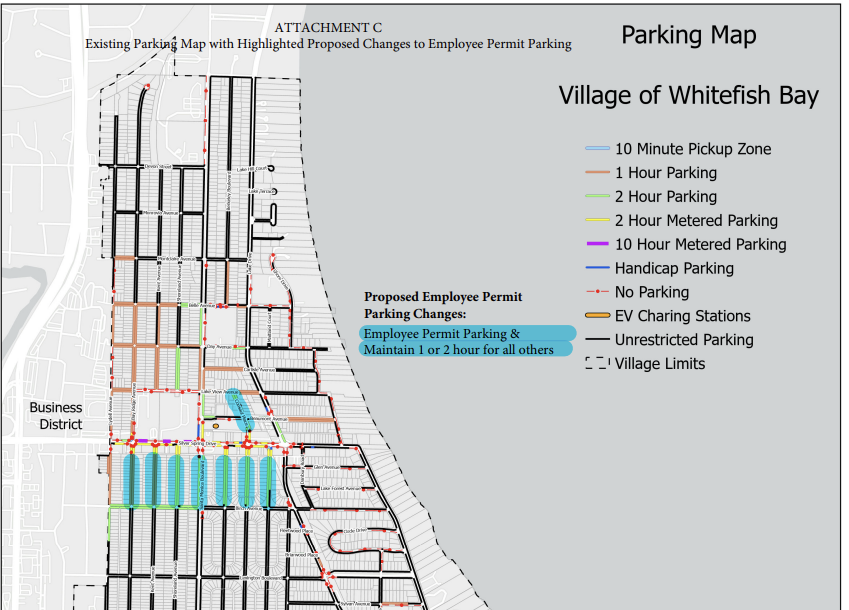
When POM started faltering, staff asked the Business Improvement District for input. The BID unanimously recommended replacing the meters with posted two-hour parking and adding long-term employee parking on side streets. Its memo suggested a six-month pilot to measure the impact with permitted employees allowed to park up to 10 hours on the southbound side of the 5500 blocks of Bay Ridge, Kent, Shoreland, Santa Monica, Berkeley, Diversey and Hollywood, plus a stretch of Consaul. Resident parking limits would not change.
The BID felt the meter situation was a good opportunity to take a step back and attempt to address a larger issue in employee parking. The thought process being that with no meters along Silver Spring, more customers would park there, opening up spots for employees in nearby side streets.
The village currently has 120 designated employee permit spaces and 495 active employee permits, though there was no data on how many of those active permits were in use at any one time or if there are truly even 495 current parking-seeking employees (since they are 2 year permits, some may no longer be working in the district).
What we heard
Residents of the 5500 blocks said their streets already absorb plenty of district parking, and having day-long parking on their block would only make the issue of getting out of their driveways, moving through the blocks, and dealing with refuse pickup difficulties worse. Several also felt the proposal was sprung on them. Business owners were more mixed than the BID’s unanimous vote might suggest. One building owner opposed 10-hour parking on the 5500 blocks and said owners should tell employees where not to park – in spots that might be more valuable to their clients. Another said his customers hate the meters and are constantly asking him for coins. Many described real trouble finding places for staff to park.
BID Executive Director Lexie Deblitz wanted to point out that the BID was responding to the village’s request in providing feedback and a proposal, not trying to shake things up in the middle of construction season, and that it’s open to alternatives.
Residents, trustees and business owners all said that the 5400 blocks (and many others throughout the village) have no restrictions and nothing is preventing employees from parking there.
One enterprising Hollywood Avenue resident took the initiative to informally poll employees around Silver Spring that day, and she shared that only one knew the 5400 blocks are unrestricted for all day parking.
Where the board landed
There was no vote, just direction by consensus. The meters will stay for now, likely hooded with QR codes pointing drivers to the ParkMobile app. Trustees felt the district is in too much flux, between Sendik’s construction, one-way traffic along Silver Spring, and a new signal on the way at Consaul Place, to get useful data from a trial. They plan to revisit in the coming months, once parking returns to both sides of the street. Long term, most trustees appeared to lean toward removing the meters for good.
In the meantime, nothing changes on the 5500 or 5400 blocks. Village Staff and business owners were directed to help educate employees on where they can park, including a potential new map of unrestricted streets. The BID will work on firmer numbers on employee parking needs. Ideas floated include adjusting Beaumont’s lots, adding angled parking on streets like Beaumont Avenue (which may require taking away green space along the parkways), and taking a harder look at parking requirements for new developments.
Stay tuned for more on this in the future.

Leave a Reply